
World
Stranger Than Heaven Cities
Stranger Than Heaven cities are five staged Japans, not one endless open world. Each district is scaled like a Like a Dragon neighborhood, with more enterable interiors and fewer dummy skyscrapers, and each is a “convincing lie” rather than a museum, as Yokoyama put it. After Gamescom, producer Hiroyuki Sakamoto added that the density of each location is the most detailed RGG has ever made. Historical events appear only when they touch Makoto. This hub is the map of maps. Deep pages now exist for all five: Kokura 1915, Kure 1929, Osaka 1943, Atami 1951, and Shinjuku 1965. How to walk them is exploration.
How to think about five cities instead of one Kamurocho
You will say goodbye to streets. That is the structural shock for series fans. Kokura’s foundry vice will not still be under your feet in 1965. Muscle memory will reset with the decade, while combat limbs will not. That pairing — new city, same body — is the campaign rhythm. Use the timeline tool when a trailer montage blends neon with steam and your brain merges them. They are not the same night.
Scale is “roughly comparable” to series districts, with more interiors. Do not expect a silent-hill alley and also do not expect a twenty-hour side-district. Expect a neighborhood you can learn, then lose to time. Substories, we are told, will not clone modern Like a Dragon side content. Minigames are fewer. The toys that do appear — arm-wrestling, dice, cards, shooting — are period rooms, catalogued below with their cities.
The five lies, in order
1915, Kokura, Fukuoka. One of the world’s largest foundries in the pitch, smoke-scorched, workers from everywhere, entertainment as drink, gambling, and pleasure because modern stages have not arrived. Orpheus lands here. Makoto learns crime and melody in the same week. Deep guide: Kokura 1915.
1929, Kure, Hiroshima. Japan’s largest naval arsenal, international social traffic, yakuza-heavy, the Iwaki Family, the Red Oni name. Entertainment is modernizing. Deep guide: Kure 1929.
1943, Minami, Osaka. Western Japan’s biggest entertainment district, wartime tension, yakuza and Italian mafia in the shadows, Makoto and Yu as showmen. Deep guide: Osaka 1943.
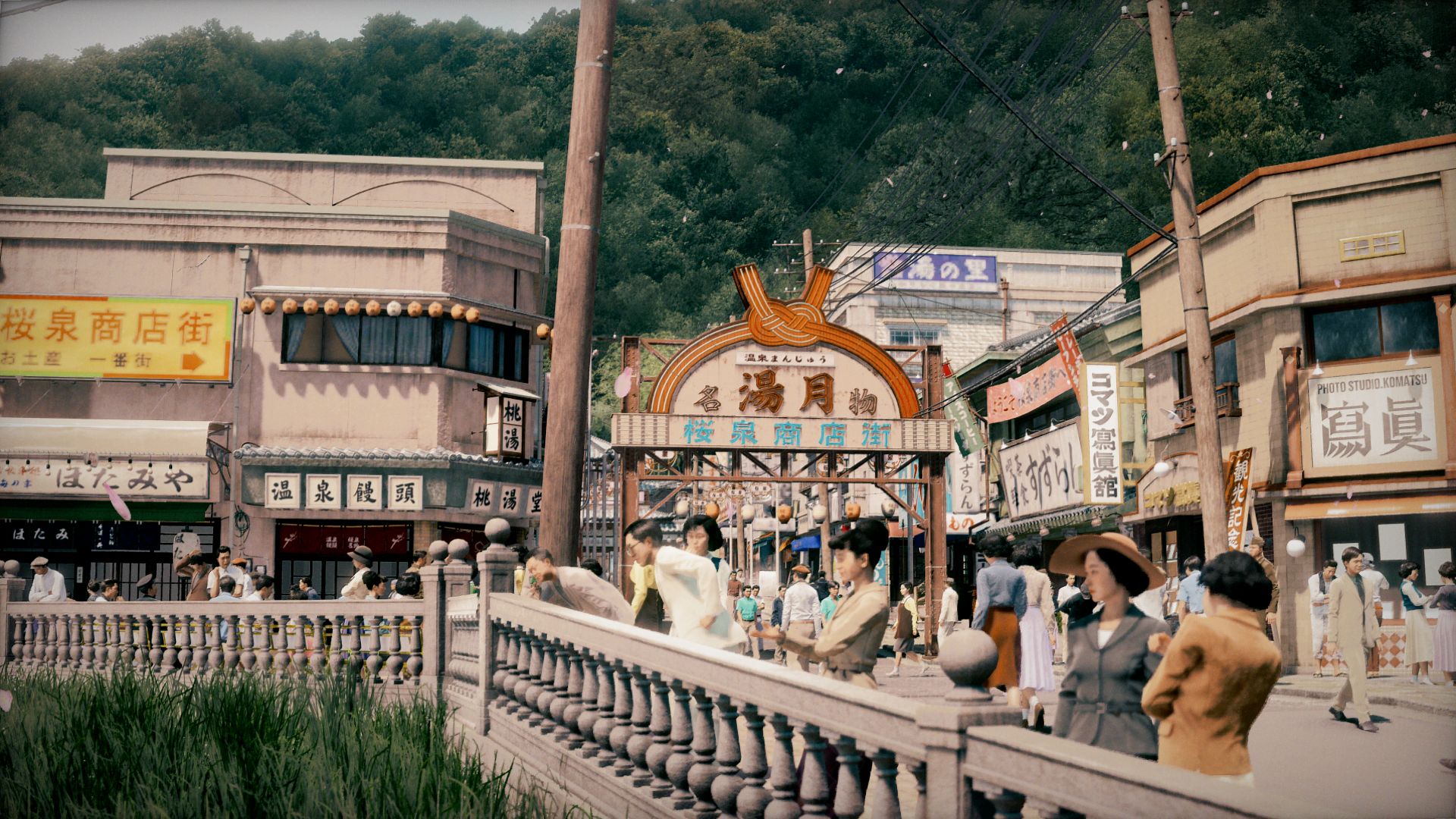
1951, Atami, Shizuoka. Seaside tourist boom, cherry-blossom postcard Japan, American language and fashion leaking in, Suzy Day’s chapter of the music war. Deep guide: Atami 1951.
1965, Shinjuku, Tokyo. Pleasure-district chaos, the Kamurocho rhyme, Yokoyama’s promised secret. Deep guide: Shinjuku 1965. Treat trailers as mood, not a walkthrough.

What the maps are for besides walking
Each city is a combat biome, a sound library, and a political weather system. Recording a broom in Kokura is not a gimmick; it is how the show loop stores 1915. A rumor in Osaka is how a singer joins the bill. A family stare in Kure is how a street fight becomes a job interview. If you only use a district as a path to the next marker, the game will feel empty in the exact way Yokoyama tried to avoid by collapsing a trilogy into one release.
Physical navigation tips are still thin because journalists were fenced into combat arenas at Summer Game Fest. Do not trust a fake alley map on social. Trust SEGA’s adjectives, the five-eras trailer in the middle of this page, and the three deep guides. When review copies add landmarks, those landmarks go on the deep pages first, then bubble up here in a table.
Series fans: Shinjuku is not a free Kamurocho save file
Famitsu coverage of Yokoyama’s remarks is the north star: Kamurocho-ish space can exist without this being a prequel recap of later heroes. If you walk into 1965 hunting Majima, you have brought the wrong save file. If you walk in hunting the feeling of a pleasure district that will later be named in other games, you are in the correct temple. The Tojo explainer is required reading before you file a complaint that someone famous did not spawn.
For shopping-minded readers: Deluxe’s record player is marketed as a way to hear era music from your base. That only sings if the five cities have already taught your ear. Buy it as a jukebox, not as a map DLC. Maps are in the base game. The editions hub will not sell you an extra Tokyo.
Frequently asked questions
Frequently asked questions
Are the cities open at the same time?
The story presents them as successive eras. A free roam that keeps 1915 open in 1965 has not been shown. Plan to leave streets behind.
Are they historically accurate?
No, by design. RGG prefers original play spaces and omits real events unless they bind to Makoto.
Which city is in the combat demo?
Journalists and the Gamescom 2026 playthrough used 1915, 1929, and 1943 combat slices. Exploration was largely locked. Sakamoto says the full cities are denser than any prior RGG map.
Keep reading