Roster
Stranger Than Heaven Characters
Stranger Than Heaven characters are a fifty-year argument about belonging. Makoto Daito wants a place that will have him. Yu Shinjo wants a country he can reshape. Orpheus wants a delivery that means something. Around them: yakuza sons, overseas singers, a veiled stranger, a late legend’s face, a late rapper’s face, and the men who will one day be spoken of as the Tojo Clan’s beginning. This hub is the relationship map. Deep dives live on Makoto Daito and the full cast list. Plot without a spoiler dump lives on the story page.
The triangle the game is actually about
Makoto is a Japanese-American orphan who stows away in 1915 because the United States will not hold him. Yu is a little older, also mixed, already more ambitious. Orpheus, Snoop Dogg’s smuggler, almost throws them overboard and then decides the cargo is the boys themselves. Cordell Broadus, Snoop’s son, plays a still-mysterious figure in that ensemble and described Orpheus realizing he was meant to deliver lives, not crates. That shipboard decision is the series premiere. Everything in Kokura — vice, foundry smoke, a hidden talent for music — grows out of who stood on that deck.
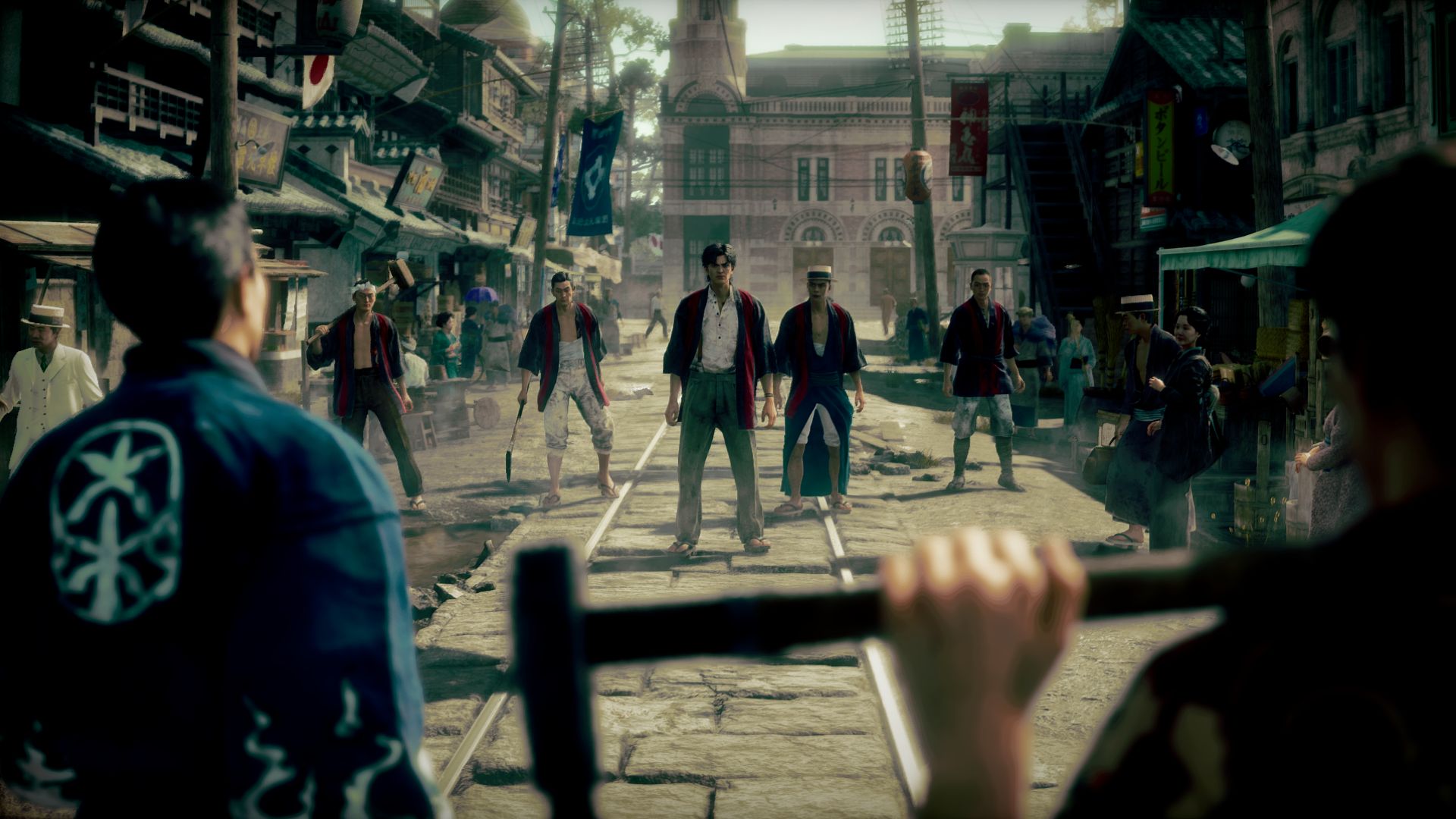
The two boys split in Fukuoka because their hungers diverge, then slam back together as show-business partners in a later chaotic stretch. Read that as the engine, not as trivia. Combat is how Makoto stays alive. Shows are how he becomes visible. Yu is the mirror that will not let either job stay simple. Details of Makoto’s casting and mixed-race framing sit on his page. Details of who plays whom sit on the cast page. This hub keeps the triangle in view so the rest of the names have a wall to hang on.
Music people are plot people
Takashi, portrayed by Official Hige Dandism’s Satoshi Fujihara, arrives through yakuza channels and becomes assistant and protégé. Suzy Day, Tori Kelly, is the overseas singer who walks into Atami’s postwar American weather and finds showbiz as ruthless as the underworld. Keiko Shirai is Ado, with an original design supervised so the singer’s real face stays private. All four of Snoop, Kelly, Ado, and Fujihara also perform the theme song. That is not cameo energy. That is the studio welding the soundtrack to the dramatis personae, which is why the show guide keeps sending you back here.
Tae Matsumoto (Moeka Hoshi), Heigo Yashima (Akio Otsuka), Kiyoshi Otsuru (Tokuma Nishioka), and others thicken the Japanese side of the ledger. The Veiled Stranger (Broadus) is still a poster with a question mark, which is rare for a RGG marketing cycle and should be treated as a live spoiler boundary. Do not invent his job. Wait for the game, then update this paragraph.
The dead are present on purpose
Genzo Iwaki uses Bunta Sugawara’s likeness with Takashi Ukaji’s voice. Amaru uses Tupac Shakur’s likeness with an unnamed voice actor, added late after Snoop introduced RGG to the estate. Yokoyama has said they spoke to families, will not use generative AI to fake the voices, and knew the choice would be criticized. Iwaki matters to Kure’s family structure — Makoto falls in with Hiroshima’s strongest organization and becomes the Red Oni. Amaru’s narrative job is not public. Both belong on a character hub because they will dominate search queries whether or not they dominate playtime.
Later-announced names — Takashi Ukaji also as Tadashi Hataoka, Takeo Godai (Takaya Kuroda), Suekichi (Kouhei Tsuji), Tetsuya Hama (Yasukaze Motomiya) — landed with the second trailer. Kuroda’s presence is catnip for Like a Dragon fans; Yokoyama still says this is not a young-Kiryu prequel. Hold both facts. The Tojo explainer is the place for the institutional reading. This page is the place for faces.
How to use this roster while playing
When a decade jumps, ask who is still in Makoto’s room. Orpheus is a 1915 gravity well. Takashi is a yakuza-music bridge. Suzy is a 1951 ignition. Yu is the fifty-year rival, which means he is never only a 1915 boy. If a fight in Kure feels like an audition, it probably is — families are watching. If a bill in Osaka feels like politics, Yu is probably in the wings. The era timeline pins these arrivals to years so you are not carrying 1965 expectations into a foundry brawl.
Voice is mixed by design: one track, language following the speaker, not a dual-audio toggle. A Japanese yakuza boss will not sound like a California smuggler. Subtitles are how you keep up. That choice is character work, not a technical footnote, and it is why the platforms page lists languages as more than a store widget. For a first read, finish Makoto’s page, skim the cast table, then go fight. Names stick after bruises.
Frequently asked questions
Frequently asked questions
Is Makoto the founder of the Tojo Clan?
Coverage and Wikipedia describe him as the eventual founder. Yokoyama still frames the game as standalone rather than a direct recap of later heroes. See the Tojo page for the careful version.
Do I need to know Kiryu or Ichiban?
No. The studio has said you do not need series knowledge and should not expect younger versions of those leads.
Why are Snoop Dogg and Tupac in a Japanese crime saga?
Orpheus is a trans-Pacific smuggler who intercepts Makoto’s crossing. Tupac’s Amaru was added after Snoop connected RGG with the estate. The theme song also features Snoop, Tori Kelly, Ado, and Fujihara.
Keep reading